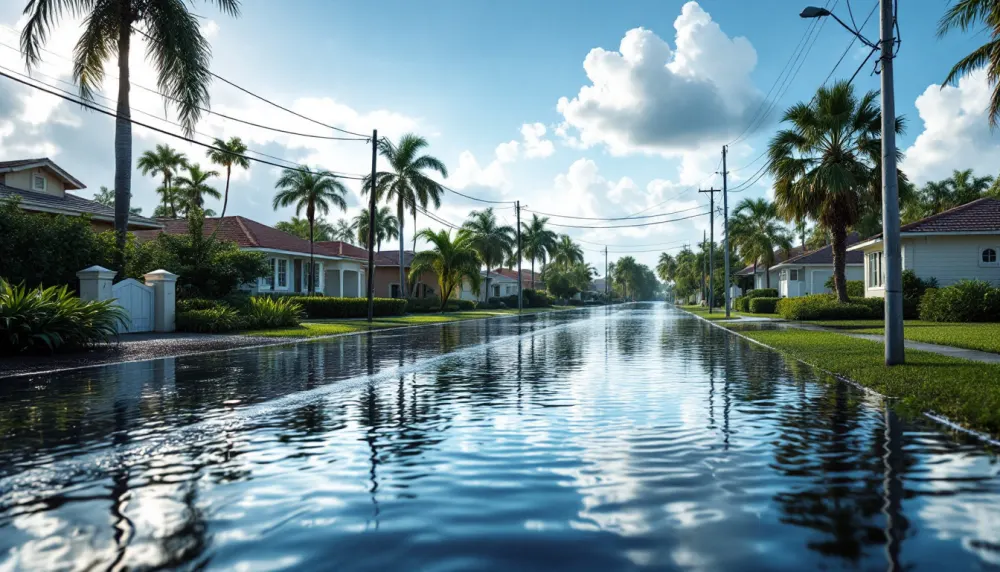
A Fort Lauderdale buyer goes under contract on a Rio Vista house, gets the flood determination back from the lender, and sees "Zone AE, BFE 8 feet" on the letter, which triggers a mandatory NFIP policy at closing and a quote three times what the seller was paying. A Weston homeowner outside every mapped flood zone loses the ground floor to an August afternoon storm that dumped nine inches in two hours, and learns the hard way that "Zone X" does not mean "no flood risk." It means "no federal requirement to buy insurance," which is a very different sentence. A Miami condo owner on Brickell reads "Zone AE" on the FEMA map, buys a $600 NFIP policy assuming that is what the neighbor down the hall pays, and finds out at renewal that the neighbor with an elevation certificate on file is paying $340 while they are paying $980 for the same building. Same city, same zone, three different lessons. All of them come down to how Florida flood zones actually work in 2026 versus how most people think they work.
This guide walks through what each FEMA flood zone (X, AE, VE, AH, AO, and the rest) actually means for a Florida property in 2026, how to look up your zone in two minutes on FEMA's Map Service Center, when your mortgage triggers the federal mandatory purchase requirement, why your zone no longer sets your NFIP premium the way it did before Risk Rating 2.0, when an elevation certificate is still worth $500 to $2,000 of your money, and what the new Citizens Property Insurance flood requirement under Florida Statute § 627.715 phases in on January 1, 2027 for policies with wind coverage.
The single most useful thing to know about Florida flood zones in 2026: your zone determines whether your lender legally requires you to carry flood insurance, but your zone no longer determines what NFIP charges you. Under Risk Rating 2.0 (phased in October 2021 for new policies and April 2022 for renewals), two houses in the same Zone AE on the same street can pay premiums that differ by thousands of dollars a year based on elevation, foundation type, distance to water, and replacement cost.
How to Find Your Florida Flood Zone in Two Minutes
The authoritative source is FEMA's Flood Map Service Center at msc.fema.gov. Type the property address into the search bar, and the site returns the Flood Insurance Rate Map (FIRM) panel that covers the property along with a zone designation. That designation (a letter code like X, AE, or VE) is the same code your lender, your insurance carrier, and your municipal building department all reference.
- Go to msc.fema.gov/portal/search and enter the property address. The site returns the FIRM panel number and the mapped zone.
- Cross-check with your county's GIS viewer. Broward County (bcgis.broward.org), Miami-Dade County (gisweb.miamidade.gov), and most Florida counties publish the same FEMA layer over aerial photography, which is easier to read than the raw FIRM.
- Ask your lender for the flood determination on file. Any federally backed loan (Fannie Mae, Freddie Mac, FHA, VA, USDA) has a Standard Flood Hazard Determination Form (SFHDF) in the closing package that names the zone as of the loan date.
- Order a full elevation certificate from a licensed Florida surveyor if you are going to buy an NFIP policy in an AE, AH, or VE zone. It is the single document that most consistently lowers a Risk Rating 2.0 premium once submitted to the carrier.
Two catches worth knowing about the MSC lookup. First, FEMA periodically restudies communities and re-issues FIRMs. A property that was mapped Zone X on a 2010 panel may be Zone AE on the 2023 revision, and vice versa. Second, the zone shown on FEMA's public tool is the mapped zone, not the current effective zone for insurance purposes; a Letter of Map Amendment (LOMA) or Letter of Map Revision (LOMR) can move an individual structure to a lower-risk zone even when the surrounding parcel is still shown as AE. Both cost money to obtain but can eliminate an unnecessary mandatory-purchase requirement for the life of the loan.
What Each Florida Flood Zone Actually Means
FEMA groups Florida properties into three broad risk categories: high-risk (Special Flood Hazard Areas, or SFHAs), moderate-to-low risk, and undetermined. Every specific zone letter falls into one of those buckets. The table below is what your lender's flood determination form is telling you when it names a zone.
| Zone | Risk level | What it means in Florida | Mandatory purchase (federal mortgage)? |
|---|---|---|---|
| VE (or V, V1–V30) | High: coastal high-hazard | Coastal areas subject to storm surge with wave action of 3 feet or more. The most expensive zone to insure. Base Flood Elevation established. | Yes |
| AE (or A1–A30) | High: 1% annual chance floodplain | The most common high-risk zone in Florida. Base Flood Elevation established. Includes most riverine, inland lake, and non-wave-action coastal flooding. | Yes |
| AH | High: shallow ponding | Shallow flooding of 1 to 3 feet, typically ponding in flat areas. BFE established. | Yes |
| AO | High: shallow sheet flow | Shallow flooding of 1 to 3 feet with velocity, typically sheet flow from higher ground. Average depth shown on the FIRM. | Yes |
| A (unnumbered) | High: 1% chance, no BFE | SFHA where FEMA has not completed a detailed study. No Base Flood Elevation is published. | Yes |
| AR / A99 | High: special | Areas behind a federal flood-control structure under restoration (AR) or where construction is underway on such a structure (A99). | Yes |
| X (shaded) | Moderate: 0.2% to 1% chance | The 500-year floodplain, or areas protected from the 100-year flood by a levee. Coverage strongly recommended but not federally required. | No |
| X (unshaded) | Minimal: outside the 500-year | Outside the mapped floodplain. Coverage optional but often available at NFIP's Preferred Risk Policy rates. | No |
| D | Undetermined | Areas of possible but unstudied flood hazard. Carriers can still write, and lenders sometimes require coverage. | Varies |
One statistic that surprises most Florida homeowners: roughly 25 percent of all NFIP claims nationwide come from properties in Zone X, where flood insurance is not federally required. Broward and Miami-Dade both had five- and six-figure claims from inland Zone X properties after the April 2023 Fort Lauderdale rain event (a reported 25.91 inches in about six hours in one gauge), a storm that had nothing to do with a mapped 100-year floodplain and everything to do with drainage systems that could not move the water fast enough.
Who Actually Has to Buy Flood Insurance in Florida
There is no state law in Florida that requires a homeowner to buy flood insurance simply because a house sits in a mapped flood zone. The mandatory purchase requirement comes from three separate sources, and it is worth knowing which one applies to your property because the consequences of dropping the coverage are different in each case.
- Federal mortgage requirement (Flood Disaster Protection Act of 1973, as amended). Any loan made, guaranteed, or purchased by a federally regulated lender or federal agency (Fannie Mae, Freddie Mac, FHA, VA, USDA, most banks) on a property in an SFHA (A, AE, AH, AO, AR, A99, V, VE) requires the borrower to carry flood insurance for at least the loan balance or the NFIP maximum, whichever is less. The lender is required by law to force-place coverage if the borrower lets the policy lapse.
- Florida Citizens Property Insurance requirement (Florida Statute § 627.715, from SB 2A passed December 2022). Personal Residential policies from Citizens that include wind coverage must have and maintain flood insurance by January 1, 2027 under a phased schedule that started with new policies in high-risk zones and works down to all Citizens policies by the deadline. A Citizens policyholder who refuses to carry flood coverage after the applicable phase date is not eligible for a Citizens personal lines residential policy.
- Private contract requirement. A private mortgage lender, an HOA, or a lease can require flood insurance regardless of zone. Coastal condo associations in Fort Lauderdale, Hollywood, and Miami Beach routinely require unit owners to carry an HO-6 with flood, even in buildings where the master policy carries flood on the building itself.
Zone X properties with cash-purchased homes and no HOA or Citizens policy in the picture have no legal requirement to carry flood, which is precisely why so many inland Broward and Miami-Dade owners were uninsured when the April 2023 event hit. Federal disaster assistance, when it comes at all, arrives as an SBA loan the homeowner has to repay, not as a grant that rebuilds the house.
Why Your Zone No Longer Sets Your NFIP Price
Before October 2021, an NFIP premium was driven mostly by the zone on the FIRM: an AE house paid AE rates, an X house paid X rates, and two AE houses on the same street generally paid within a few hundred dollars of each other. That model is gone. Under Risk Rating 2.0, NFIP prices each individual structure based on property-specific characteristics, and the zone matters much less than most Florida homeowners assume.
What Risk Rating 2.0 actually looks at
- Distance to the nearest flooding source (ocean, river, lake, canal, or drainage feature).
- Type of flooding the property is most exposed to (coastal storm surge, riverine overflow, pluvial rainfall, or a combination).
- First-floor height relative to the Base Flood Elevation (this is where an elevation certificate pays for itself).
- Foundation type (slab-on-grade, crawlspace, elevated on piers, basement, or enclosure with breakaway walls).
- Rebuilding cost of the specific structure (a 1,400-square-foot slab home and a 6,000-square-foot beachfront home in the same VE zone are priced very differently).
- Flood frequency modeling from FEMA's catastrophe model, which considers multiple hazard types rather than a single 1-percent-chance line.
The practical effect in Broward and Miami-Dade in 2026: two homes on the same street in the same Zone AE routinely quote at premiums that differ by a factor of two or three. An elevated CBS home two feet above BFE with a slab foundation might pay $450 a year. The neighbor with a first-floor slab at BFE and an enclosed garage below might pay $1,800 for materially the same coverage. The zone letter is identical; the property-specific inputs are not.
Risk Rating 2.0 also introduced statutory rate caps. Most existing NFIP policyholders cannot see their premium increase more than 18 percent per year at renewal. If you are new to the property or shopping a first NFIP quote, that cap does not help you; the full Risk Rating 2.0 price applies from day one. Buyers taking over an existing home should ask the seller for the current declarations page and consider whether assumption of the existing policy (allowed on NFIP policies) preserves any grandfathered pricing worth keeping.
When an Elevation Certificate Is Still Worth the Money
One of the most persistent misconceptions after Risk Rating 2.0 launched is that elevation certificates no longer matter. That is not quite right. Elevation certificates are no longer required to purchase NFIP coverage. FEMA uses its own automated elevation data to price the policy at binding. But a Florida homeowner can voluntarily submit an elevation certificate to the NFIP after binding, and if the certificate shows the structure is higher than FEMA's automated estimate assumed, the premium drops accordingly.
- A licensed Florida surveyor typically charges $500 to $2,000 for an elevation certificate, depending on the property's complexity and the surveyor's schedule during hurricane season.
- An AE-zone home whose EC shows the finished floor 2 feet above BFE can see premium reductions in the range of 30 to 45 percent, often $600 to $1,500 per year, depending on the other property-specific inputs.
- The downside risk is minimal: if the EC shows the property is lower than FEMA's automated estimate assumed, NFIP will not retroactively raise the premium. The higher rate applies only if you affirmatively submit the certificate.
- For a VE-zone home, the EC also documents whether the lowest horizontal structural member is above or below BFE, which is the single biggest driver of a VE premium.
The math almost always favors ordering the EC when the property is elevated at all: a raised CBS home, an elevated pier foundation, a house with fill under the slab that puts the finished floor above the surrounding grade. For a slab-on-grade home right at BFE on a flat lot, the EC will simply confirm what FEMA already estimated and the certificate cost is money spent. Ask an insurance agent to model the two scenarios before you commission the survey.
What to Do If You Just Learned You Are in AE or VE
Most Florida buyers discover the flood zone the same way: the flood determination comes back during underwriting, the letter names an SFHA zone, and the lender adds a mandatory NFIP requirement to the closing conditions. The default move (bind whatever NFIP quote the lender's flood service produces and move on) usually leaves money on the table and often leaves the property underinsured. A few checks are worth running before closing.
- Get a private flood quote alongside the NFIP quote. Private carriers (Neptune, TypTap, Zurich, Hiscox, Wright, and others) write in Florida with dwelling limits well above the $250,000 NFIP cap, contents limits above $100,000, and shorter waiting periods (often 10 to 14 days versus NFIP's 30). For a Fort Lauderdale or Miami property valued above $400,000, private is usually the better product.
- Check whether the property qualifies for a Letter of Map Amendment. If a licensed surveyor can document that the lowest adjacent grade is above the BFE, a LOMA-Out can remove the property from the SFHA on paper and eliminate the federal mandatory purchase requirement. LOMAs are free to file with FEMA; the surveyor's work is the cost.
- Ask your homeowners carrier about the flood exclusion in writing. Every HO-3 and HO-5 policy in Florida excludes flood, but the exclusion wording can differ. Wind-driven rain that enters through a wind-damaged roof is usually covered under the wind peril; the same water rising up through a sliding-door threshold is flood and excluded. Knowing which is which changes how a claim is presented.
- If the property is a Citizens policyholder, plan for the § 627.715 flood requirement now. The phased deadline of January 1, 2027 will apply to every Citizens Personal Residential policy with wind coverage. Binding flood coverage in 2026 avoids a scramble at renewal.
For coastal Broward and Miami-Dade properties (the barrier islands, the Intracoastal-facing streets in Fort Lauderdale, most of Miami Beach, and every ZIP code within a mile of the ocean) the practical assumption should be that flood coverage will be required and that private flood is worth pricing alongside NFIP. For inland properties in Weston, Pembroke Pines, Coral Springs, Sunrise, or western Miami-Dade, the zone may be X and the requirement may be zero, but the April 2023 event is a fair reminder that a Zone X designation is a statement about federal insurance requirements, not a guarantee about how the property will drain in the next 200-year storm.