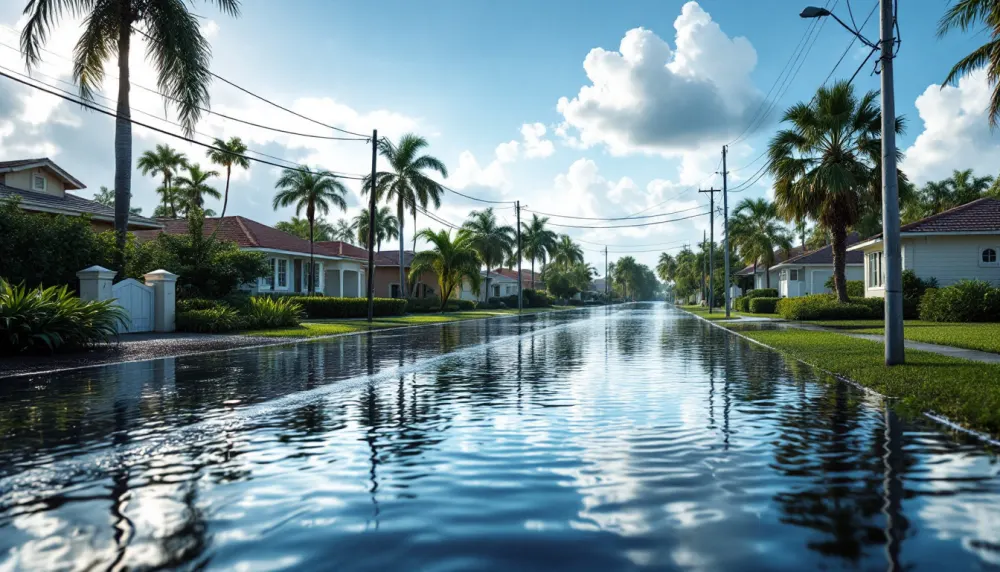
Florida faces more flood risk than any other state. With roughly 2 million active NFIP policies (the most in the nation) and billions paid out in claims since 1978, flooding is not a question of if but when for many properties. Yet flood damage is excluded from every standard homeowners policy in the state. Whether you live in a high-risk coastal zone or a neighborhood miles from the nearest canal, this guide covers everything you need to know about flood insurance in Florida for 2026, including how FEMA’s pricing works, when private flood insurance makes more sense, and what steps you can take now to protect your home before hurricane season.
Why Flood Insurance Is Essential in Florida
Florida properties have generated over 448,000 NFIP flood claims totaling $19.2 billion in payouts since the program began. The average flood claim pays out roughly $28,500, enough to wipe out a family’s savings. And the risk extends well beyond high-hazard zones: more than 40% of all NFIP claims nationwide come from properties outside designated high-risk flood areas. In Florida, where summer thunderstorms can dump several inches of rain in under an hour and aging drainage infrastructure struggles to keep up, flooding can happen virtually anywhere.
Just one inch of floodwater in your home can cause more than $25,000 in damage, according to FEMA. Standard homeowners insurance does not cover any of it.
Florida faces multiple types of flood threats: hurricane storm surge, heavy rainfall that overwhelms storm drains, rising tides amplified by sea-level rise, and compound flooding where storm surge, high tides, and heavy rain align simultaneously. Rapid intensification of hurricanes (fueled by increasingly warm Gulf waters) also shortens the window homeowners have to prepare, making year-round coverage critical.
FEMA’s National Flood Insurance Program (NFIP)
The NFIP is a federal program administered by FEMA that provides flood insurance to homeowners, renters, and businesses in participating communities. It remains the most widely used flood insurance option in Florida, but it comes with important limitations.
NFIP Coverage Limits
| Coverage Type | Residential Limit | Commercial Limit |
|---|---|---|
| Building / Dwelling | $250,000 | $500,000 |
| Contents / Personal Property | $100,000 | $500,000 |
| Additional Living Expenses | Not covered | Not covered |
These coverage caps have not been adjusted in over 20 years. For South Florida homeowners with properties valued well above $250,000, this gap can leave hundreds of thousands of dollars unprotected.
How NFIP Pricing Works: Risk Rating 2.0
Since April 2023, FEMA has used Risk Rating 2.0 to calculate premiums. This system replaced the older zone-based model with individualized, property-specific pricing. Your premium is now determined by your property’s specific flood frequency, distance to water sources, elevation, the cost to rebuild, and exposure to multiple flood types including river overflow, storm surge, coastal erosion, and heavy rainfall.
Under this system, two homes on the same street may have significantly different premiums. Nationally, 77% of policyholders saw premium increases when Risk Rating 2.0 took effect, while 23% saw decreases. Annual premium increases are capped at 18% per year for primary residences by federal statute, so rates are rising gradually toward their full actuarial level.
What NFIP Covers
- The building structure and its foundation
- Electrical and plumbing systems
- Central air conditioning, furnaces, and water heaters
- Permanently installed appliances (refrigerators, stoves, dishwashers)
- Permanently installed carpeting, cabinetry, and built-in bookcases
- Detached garages (up to 10% of building coverage)
- Clothing, furniture, and electronics (under contents coverage)
What NFIP Does Not Cover
- Additional living expenses or temporary housing while your home is repaired
- Outdoor property: landscaping, fences, decks, pools, and seawalls
- Finished basement walls, floors, ceilings, and personal items stored in basements
- Vehicles (covered under comprehensive auto insurance instead)
- Cash, precious metals, and valuable papers
- Mold or mildew damage that could have been prevented
- Earth movement, even if caused by flooding
NFIP pays building claims on a primary residence at replacement cost value, but contents claims are always paid at actual cash value, meaning depreciation is deducted. A five-year-old couch will not be replaced with a new one.
Private Flood Insurance: A Growing Alternative
Florida’s private flood insurance market has expanded significantly in recent years, and for many homeowners it offers better coverage at lower cost than the NFIP. Private carriers like Neptune Flood, Wright Flood, and others now write policies across the state with notable advantages.
| Feature | NFIP | Private Flood |
|---|---|---|
| Maximum Dwelling Coverage | $250,000 | $1M–$10M+ |
| Maximum Contents Coverage | $100,000 (ACV) | Higher limits (often RCV) |
| Additional Living Expenses | Not covered | Typically $25,000–$75,000+ |
| Contents Valuation | Actual Cash Value | Replacement Cost available |
| Standard Waiting Period | 30 days | 10–15 days |
| Typical Cost vs. NFIP | Baseline | Often 20–50% less |
Private flood insurance is particularly valuable for homeowners whose properties are worth more than the NFIP’s $250,000 cap, for anyone who wants replacement cost coverage on personal belongings, and for those who need additional living expense coverage to pay for temporary housing during repairs.
Private policies are accepted by all federally backed mortgage lenders (Fannie Mae, Freddie Mac, FHA, VA) as long as the policy meets the requirements of the Biggert-Waters Act. Your lender may need to review the policy, but private flood insurance satisfies the mandatory purchase requirement.
Florida Flood Zones Explained
FEMA designates flood zones on Flood Insurance Rate Maps (FIRMs) to indicate varying levels of risk. Understanding your zone is essential for knowing your insurance requirements and expected costs.
High-Risk Zones (Flood Insurance Required for Federally Backed Mortgages)
- Zone AE: The most common high-risk designation in Florida. Located within the 100-year floodplain with an established Base Flood Elevation (BFE). Properties face a 26% chance of flooding during a 30-year mortgage.
- Zone VE: Coastal high-hazard areas subject to storm surge with wave action of three feet or more. This is the most expensive zone to insure.
- Zone A: High-risk area within the 100-year floodplain where no Base Flood Elevation has been determined.
- Zone AH: Areas of shallow flooding (one to three feet) with established BFE, typically areas prone to ponding.
Moderate-to-Low-Risk Zones (Insurance Not Federally Required)
- Zone X (shaded): Moderate risk, located in the 500-year floodplain. Insurance is recommended but not required.
- Zone X (unshaded): Minimal risk, outside both the 100-year and 500-year floodplains. However, “minimal risk” does not mean “no risk.” Over 40% of NFIP claims come from these zones.
You can look up your property’s flood zone for free at FEMA’s Flood Map Service Center (msc.fema.gov). Enter your address to view the current Flood Insurance Rate Map for your area.
Average Flood Insurance Costs in Florida
Flood insurance costs in Florida vary widely based on your property’s specific risk profile under Risk Rating 2.0. Here are general ranges to expect:
| Risk Level / Zone | Typical Annual Premium |
|---|---|
| Low-risk zones (Zone X) | $400–$900 |
| Moderate-risk zones | $700–$1,500 |
| High-risk zones (Zone AE) | $1,200–$4,000+ |
| Coastal high-hazard (Zone VE) | $2,000–$15,000+ |
| Florida Keys (Monroe County avg.) | ~$4,700 |
Properties that are elevated above base flood elevation, built after the year 2000, and located in moderate-risk zones tend to qualify for the most competitive rates from both NFIP and private carriers. An independent agent who shops both markets can often find significant savings.
Florida’s New Flood Insurance Mandate: SB 2A
Florida enacted SB 2A, creating the nation’s first statewide flood insurance mandate. The law targets policyholders who carry wind coverage through Citizens Property Insurance and requires them to also carry flood insurance, regardless of their flood zone.
Phased Implementation Timeline
- Already in effect: Citizens policyholders with properties in Special Flood Hazard Areas (any dwelling value).
- January 1, 2026: Extends to Citizens policyholders with dwellings valued at $400,000 or more.
- January 1, 2027: Applies to all remaining Citizens policyholders with wind coverage, regardless of home value.
If you currently have or are considering a Citizens policy, you should factor flood insurance into your total insurance budget now. An agent can help you find the most cost-effective flood policy before the mandate applies to your property.
Waiting Periods: Don’t Wait Until Storm Season
NFIP policies have a standard 30-day waiting period from the date of purchase before coverage takes effect. This exists to prevent panic-buying ahead of approaching storms. Private carriers typically have shorter waiting periods of 10 to 15 days.
Exceptions to the NFIP 30-Day Wait
- New mortgage or refinance closing: waiting period is waived entirely.
- Flood map changes: reduced to one day if purchased within 13 months of a new high-risk zone determination.
- Policy renewal or coverage changes: no waiting period applies.
Hurricane season runs June 1 through November 30. If you purchase an NFIP policy on June 1, you will not be covered until July 1. Buy your flood policy well before storm season begins.
NFIP Reauthorization: What’s at Stake
The NFIP must be reauthorized by Congress periodically and is currently authorized through September 30, 2026. The program has been extended more than 30 times through short-term reauthorizations since 2017. While a lapse would not cancel existing policies, FEMA cannot issue new policies or renew existing ones during a lapse. Legislation currently before Congress (H.R. 5484) proposes extending the program through 2030.
How to Lower Your Flood Insurance Costs
- Shop both NFIP and private carriers through an independent agent who has access to multiple markets.
- Obtain an Elevation Certificate to verify your property’s elevation relative to the Base Flood Elevation. This can sometimes result in a lower premium.
- Invest in flood mitigation: elevating utilities, installing flood vents, or raising the structure can reduce long-term costs.
- Choose a higher deductible if you have adequate emergency savings to self-insure the initial portion of a loss.
- Take advantage of Florida’s My Safe Florida Home program, which provides matching grants for eligible property improvements.
- Review your policy annually: flood maps and risk ratings change, and better options may become available.
The Bottom Line
Flood insurance is not optional for most Florida property owners. It is a financial necessity. Whether you are in a high-risk coastal zone or a neighborhood that has never flooded, the data shows that flood risk is real and growing statewide. The 30-day waiting period means the time to act is now, not when a storm is in the forecast. An independent agent who shops both the NFIP and private markets can help you find the right coverage for your property at the best available price.