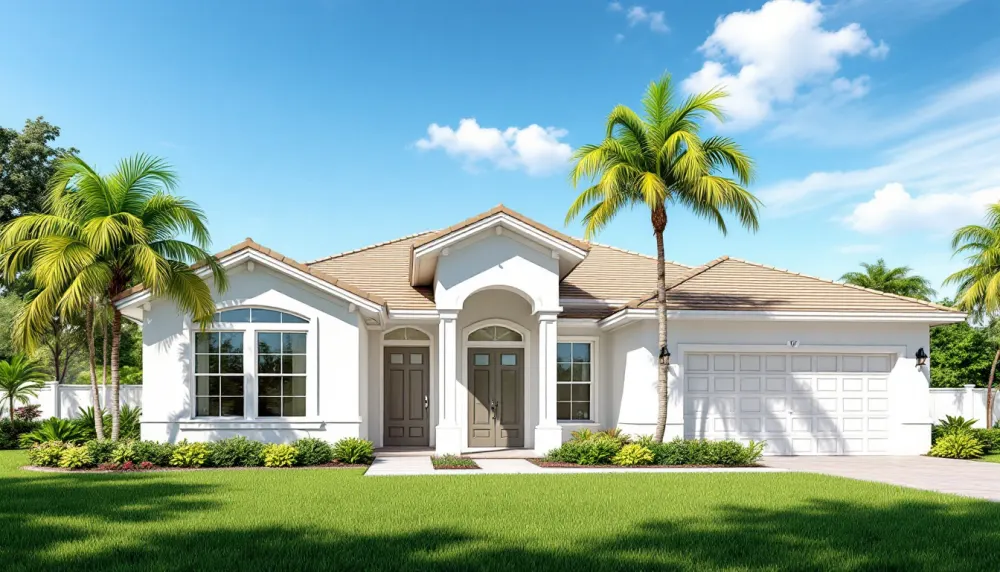
Florida has the most expensive homeowners insurance in the country. Average premiums in 2026 sit somewhere between $5,500 and $8,000 a year depending on the data source, county, roof age, and coverage limits. That is roughly three to four times the national average, and it is why every Florida homeowner ends up asking the same two questions: what am I actually paying for, and why is it this much?
This guide walks through both. It explains what a Florida HO-3 policy covers under each numbered coverage, what is excluded, the difference between replacement cost and actual cash value (and why that single choice changes your payout more than any deductible), why Florida premiums are so high, and how the 2022-2023 reforms are now showing up as 2026 rate decreases. By the end you will know what to look at on your declarations page and what to ask your agent at renewal.
What a Florida HO-3 Policy Actually Covers
Almost every Florida homeowners policy is written on the HO-3 form, also called the special form. The HO-3 covers the structure itself on an open-perils basis (everything is covered except what the policy specifically excludes) and personal property on a named-perils basis (only the specific causes of loss listed in the policy are covered). The policy is divided into six numbered coverages.
| Code | Coverage | What It Pays For |
|---|---|---|
| A | Dwelling | The main structure of your home, including built-in features (kitchen cabinets, plumbing, wiring). Paid on a replacement cost basis if you carry RCV. |
| B | Other Structures | Detached structures: fences, sheds, detached garages, gazebos. Typically 10% of Coverage A. |
| C | Personal Property | Your contents: furniture, clothing, electronics, appliances. Typically 50% to 70% of Coverage A. Sub-limits apply for jewelry, firearms, and cash. |
| D | Loss of Use | Hotels, rentals, meals, and other additional living expenses if the home is uninhabitable. Typically 10% to 20% of Coverage A. |
| E | Personal Liability | Legal defense and damages if someone is injured on your property or you cause injury or damage off-premises. Standard limit $100K to $500K. |
| F | Medical Payments | No-fault medical bills for guests injured on your property, regardless of fault. Standard limit $1,000 to $5,000. |
Coverage A is the number that matters most, and it is also the one most often set wrong. Coverage A is the dollar amount your insurer will pay to rebuild your home from the foundation up, not the price you paid for it and not the tax-assessed value. Florida construction costs have moved up materially over the last several years. A Coverage A limit that was correct in 2019 is probably underinsuring you in 2026. Ask your agent for an updated replacement cost estimate every two or three years, and after any major renovation.
Florida Statute § 627.7011 requires every insurer to offer replacement cost coverage at the time you buy a policy. If you signed an actual cash value policy, you signed away the difference. You can usually switch to RCV at renewal if your roof and overall condition still qualify.
What Florida Homeowners Insurance Does Not Cover
The bigger surprises for new Florida homeowners come from understanding the exclusions, not the coverages. Five categories of damage are excluded or sharply limited on a standard Florida HO-3.
Flood
This is the largest single exclusion in the country and the one Florida homeowners most often miss. Storm surge, rising water from rainfall, river or canal overflow, and water backing up from overwhelmed drainage are all flood, and flood is excluded from every standard HO-3 sold in Florida. You need a separate flood policy from either the National Flood Insurance Program (NFIP) or a private flood carrier. FEMA data show more than 40% of flood claims come from properties outside high-risk flood zones.
Earthquake
Excluded. Florida rarely makes anyone's mental map for earthquake risk, but if you want the coverage you would have to add it by endorsement, and most carriers in the state do not write the endorsement at all.
Sinkholes (Beyond Catastrophic Ground Cover Collapse)
Florida Statute § 627.706 requires every homeowners insurer to include coverage for catastrophic ground cover collapse, but the statutory definition is narrow. The ground has to abruptly collapse, there has to be a visible depression at the surface, and the structural damage has to be severe enough that the local building department condemns the home as uninhabitable. Slow settling, hairline cracks, and minor structural movement do not qualify. Full sinkhole coverage is a separate endorsement that usually requires geological testing on the property before the carrier will write it, with higher deductibles and added premium.
Mold
Mold is typically excluded as a stand-alone cause of loss and capped at a low sub-limit (often $10,000) when it results from a covered peril such as a sudden burst pipe. Mold from long-standing humidity, a slow plumbing leak, or poor ventilation is not covered at all. If you want a higher mold limit, ask your agent whether the carrier offers an endorsement and what it costs.
Wear and Tear, Maintenance, and Neglect
Insurance pays for sudden and accidental damage, not for deferred maintenance. A 25-year-old water heater that finally fails, a roof that wore out from age rather than a storm, or rot from a leak you knew about and ignored will all be denied. This is the single most common reason claims get reduced or denied in Florida. Insurers track the age of the major systems (roof, HVAC, plumbing, electrical) and underwrite accordingly.
Replacement Cost vs Actual Cash Value: The Single Most Important Choice
Two policies with identical Coverage A limits can pay very different amounts on the same claim, and the reason is whether they pay replacement cost (RCV) or actual cash value (ACV). RCV pays what it costs to repair or replace the damaged property today, with no deduction for age or wear. ACV pays the depreciated value: replacement cost minus the wear and tear that has accumulated since the item was installed.
| Scenario | RCV Payout | ACV Payout |
|---|---|---|
| 10-year-old shingle roof, $25,000 to replace, 40% depreciation | $25,000 minus deductible | $15,000 minus deductible |
| 8-year-old refrigerator, $1,800 to replace, 60% depreciation | $1,800 minus deductible | $720 minus deductible |
| 3-year-old roof, hurricane damage, $30,000 to replace | $30,000 minus deductible | $26,000 minus deductible (modest depreciation) |
The trap in Florida is the roof. Even on a policy that is RCV overall, many carriers will write the roof as ACV-only once it passes 15 or 20 years old. That means a 20-year-old roof totaled by a hurricane gets paid out at depreciated value, not at the cost of a new roof. If your roof is approaching that age and your declarations page shows ACV on the roof, your real exposure on a total-loss claim is much larger than your hurricane deductible alone.
Even on an RCV policy, the first claim check is often the actual cash value amount. The depreciation portion, called recoverable depreciation, is paid only after you complete the repair and submit receipts. Plan your cash flow accordingly: you may need to front the ACV-to-RCV gap before you see the second check.
Why Florida Premiums Are So High
Premium is set by what carriers expect to pay out in claims plus what it costs to run the business. In Florida, four cost drivers stack on top of each other in a way that does not happen in any other state.
- Hurricane exposure. Florida has roughly 1,350 miles of coastline and sits between the Atlantic and Gulf basins. Every property in the state carries some catastrophic wind risk, which means every premium has a catastrophic-wind load built into it. NOAA attributes more than 30 billion-dollar weather and climate disasters to Florida since 2020.
- Reinsurance costs. Florida insurers buy large amounts of reinsurance to protect against catastrophic seasons. Global reinsurance prices spiked between 2022 and 2023 and have only partially softened in 2025 and 2026. Those costs are passed straight through to consumer premiums.
- Litigation. Florida has historically generated a disproportionate share of homeowners insurance lawsuits relative to its share of claims. The 2022-2023 reforms targeted this directly (more below), but legal-cost reserves built up over years are still working through the system.
- Rebuilding inflation. Labor and materials in Florida have risen faster than the national construction cost index. After a storm, surge demand for tarps, roofers, and drywall crews pushes those prices higher still. Higher rebuilding costs mean higher Coverage A limits, which mean higher premiums.
Add 17 carrier insolvencies between 2017 and 2025, the exit of several large national writers from the Florida homeowners market, and the resulting concentration of business with Florida-only carriers, and the cost stack becomes the most expensive in the United States by a wide margin.
What Changed in 2022 and Why 2026 Is Different
Governor DeSantis signed SB 2-A into law on December 16, 2022. The bill made two structural changes that have reshaped the math for Florida insurers. First, it eliminated the one-way attorney fee provision in Florida Statute § 627.428 for residential property insurance suits, removing the asymmetric incentive that drove most of the state's homeowners insurance litigation. Second, it banned the assignment of post-loss benefits (AOBs) on residential property policies issued on or after January 1, 2023, ending a practice in which contractors took over claims and sued carriers directly.
Three years on, the effects are showing up in rate filings. Citizens Property Insurance approved an average rate reduction of roughly 8.8% for 2026, its first meaningful personal-lines decrease since 2015. State Farm filed for a statewide 10% reduction. Florida Peninsula proposed an 8.4% cut. New carriers have entered the state for the first time in years, and Citizens has shrunk from a peak of 1.41 million policies in late 2023 to roughly 336,000, reducing the systemic risk of post-hurricane assessments on every Florida policyholder.
Florida rates are still the highest in the country, but the direction has changed. If your renewal in 2026 still shows a double-digit increase, that is a signal to re-shop, not to absorb the hike. Several carriers writing new business in 2026 will quote below your current carrier's renewal.
How to Actually Lower Your Premium
Most premium savings in Florida come from a short list of specific actions. Working an independent agent through this list is the fastest way to see real reductions at renewal.
- Get a wind mitigation inspection. Florida Statute § 627.0629 requires every insurer to offer premium credits for verified wind-resistant construction features (hip roofs, secondary water barriers, impact-rated openings, reinforced roof-to-wall connections). Inspections typically run $75 to $150 and can return savings of several hundred to several thousand dollars a year on the wind portion of your premium.
- Apply for My Safe Florida Home. The state program covers free wind-mitigation inspections and matching grants of up to $10,000 for approved improvements (impact windows, garage-door reinforcement, roof hardening). The 2025-2026 budget allocated $280 million; the proposed 2026-2027 budget pushes that figure past $600 million to clear the backlog.
- Raise your hurricane deductible carefully. Moving from a 2% to a 5% hurricane deductible can cut 10% to 20% off the wind premium. Only do this if you can put the new deductible amount in a dedicated savings account first; otherwise you are trading premium savings for an out-of-pocket exposure you cannot actually pay.
- Bundle home and auto. Multi-policy discounts in Florida typically run 10% to 25% across home and auto combined. An independent agent can mix carriers within the bundle if a single-carrier package is not the lowest combined price.
- Replace an aging roof before underwriting forces you out. Most carriers stop offering full RCV on roofs older than 15 to 20 years. A new roof returns to full RCV, often unlocks impact-resistant material credits, and meaningfully widens the carrier field that will write you.
- Watch your claims history. A single weather claim can move you into a surcharged tier or out of a preferred carrier's appetite entirely. Pay small repairs out of pocket; save the policy for the events that actually need it.
- Maintain your insurance score. Most Florida personal lines carriers use a credit-based insurance score in rating. Keeping credit lines paid on time and credit utilization low feeds directly into a lower premium.
- Re-shop every renewal. The Florida carrier landscape is moving fast in 2026, with new entrants and meaningful rate filings on both sides. A renewal that auto-pays is leaving real savings on the table.
The Bottom Line
Florida homeowners insurance is expensive because Florida is the highest-catastrophe homeowners market in the country, but the policy itself is straightforward. An HO-3 has six numbered coverages, a hurricane deductible expressed as a percentage of Coverage A, a roof component that may be RCV or ACV depending on age, and a stack of exclusions (flood, earthquake, sinkhole beyond CGCC, mold, wear) that you handle with separate policies or endorsements. The 2022 reforms have produced the first meaningful rate cuts in over a decade, and 2026 is the first renewal cycle where a shopper with an independent agent and a clean wind-mitigation report can actually drive premium down. Read your declarations page, ask the questions in this guide, and re-quote at renewal. The numbers move in your favor when you do.