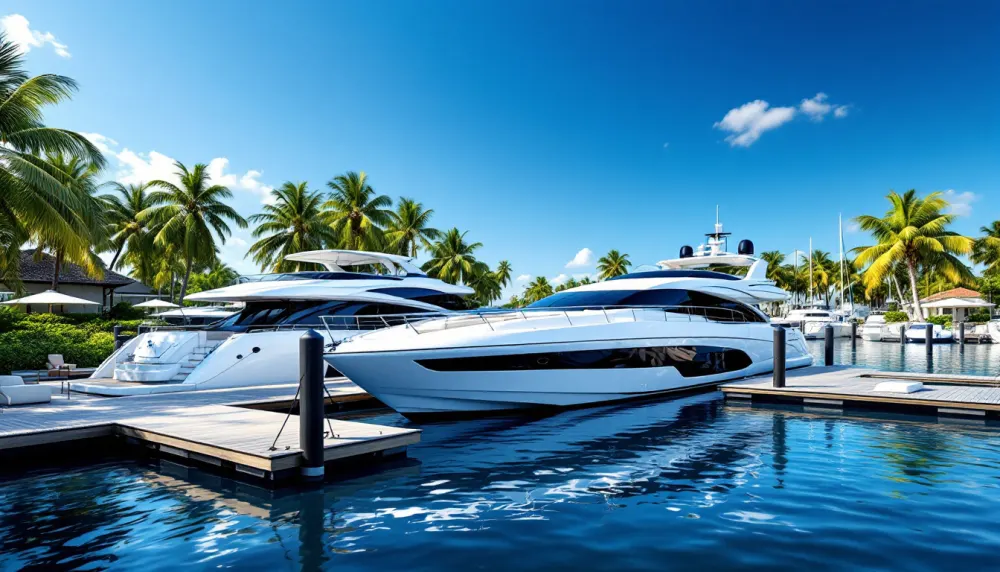
Fort Lauderdale is called the yachting capital of the world for a reason. The city and its Broward County neighbors sit on more than 300 miles of navigable waterway, host over 100 marinas, and every fall welcome the Fort Lauderdale International Boat Show, the largest in-water show on the planet. Layer in Miami-Dade's yacht basins from Coconut Grove to Miami Beach, and South Florida is home to one of the densest concentrations of large recreational vessels anywhere in the country. Yet the coverage most owners are handed at closing is a stock recreational form built for a 24-foot center console, not a properly written yacht policy on an eight-figure hull.
This guide walks through what actually counts as a yacht for insurance purposes, whether Florida law requires you to carry coverage, what a real yacht policy includes, how agreed value and named-storm deductibles behave when a hurricane threatens Broward County or Miami-Dade, what the Bahamas and Caribbean navigation territory endorsements cost, the survey and layup clauses buried in most yacht forms, and roughly what a Florida yacht policy costs in 2026 by hull value and vessel type.
A yacht policy is a different animal from a small-boat policy. It uses different underwriters, different forms (often based on Institute Yacht Clauses or a proprietary all-risk hull form), different deductible math, and different warranties. If your 55-foot motoryacht is sitting on a standard recreational form written for a bay boat, you have a problem the first time a claim gets adjusted.
What Counts as a Yacht for Insurance Purposes
There is no universal legal definition of a yacht. Marine carriers draw the line based on hull length, hull value, and use. The industry rule of thumb across South Florida is that any vessel roughly 27 feet or longer, or with an insured hull value above about $100,000, moves out of a standard boat policy and onto a yacht form. Sailing yachts often cross the threshold at a smaller length overall because sail rigs, keels, and interiors push replacement cost up.
The move from boat policy to yacht policy matters because the coverages, exclusions, and premium base all change.
- Hull form: yacht policies are usually written as all-risk hull coverage on an agreed-value basis, subject to specific exclusions. Standard boat policies are more often named-perils.
- Liability: yacht policies use Protection and Indemnity (P&I) language borrowed from commercial ocean marine, which covers pollution, fuel spill, wreck removal, and crew liability more cleanly than a recreational liability form.
- Deductible math: yacht policies almost always apply a percentage-of-hull-value named-storm deductible in Florida, while the all-other-perils deductible is often percentage-based as well on larger vessels.
- Warranties: yacht policies attach survey warranties, lay-up warranties, and hurricane plan warranties that boat policies rarely carry.
- Navigation: yacht policies typically ship with a stated navigation territory (US coastal, Great Lakes, Bahamas, Caribbean, Bermuda) and require an endorsement to change it. Small-boat policies are usually silent on limited-territory questions.
Is Yacht Insurance Required in Florida?
Florida is one of only two states, along with Alabama, that does not impose a statewide insurance mandate on private recreational vessels. Chapters 327 and 328 of the Florida Statutes govern recreational boating safety and vessel titling and registration through the Florida Department of Highway Safety and Motor Vehicles, but neither chapter requires a private yacht owner to carry insurance on the hull or the liability. That does not mean you can dock a $2 million yacht in Fort Lauderdale without coverage. Four parties will require it before you get very far.
- Marinas. Almost every wet-slip and dry-storage agreement in Broward County and Miami-Dade requires proof of marine liability coverage. Standard minimums are $500,000 to $1 million on smaller yachts, $2 million to $5 million on larger vessels or slips at premium marinas. The marina is named as additional insured.
- Lenders. If the yacht is financed, the loan agreement requires agreed-value hull coverage equal to the loan balance plus liability. The lender is listed as loss payee. Lapsing this coverage triggers force-placed insurance from the lender at a much higher premium than a normal market policy.
- HOAs and private-dock agreements. Waterfront communities across Fort Lauderdale, Pompano Beach, and coastal Miami-Dade require proof of liability before issuing a vessel decal or dock permit.
- Foreign ports. The Bahamas, most Caribbean islands, and Bermuda expect proof of P&I liability at $1 million or more before you clear customs and receive a cruising permit. A Bahamas endorsement on your policy is the standard evidence marinas and customs will accept.
What a Florida Yacht Policy Actually Covers
A properly written yacht policy is built from a small set of coverages, usually on a single form with clearly separated limits. The exact language varies by carrier, but the underlying protections are consistent across the specialty market.
| Coverage | What It Pays | Typical Limit |
|---|---|---|
| Hull / Physical Damage (all-risk) | Damage to the yacht, machinery, tenders, and permanently attached equipment from collision, fire, theft, vandalism, sinking, and named storms. | Agreed value of the yacht |
| Protection & Indemnity (P&I) | Third-party bodily injury and property damage on the water or at the dock, including crew liability on larger vessels. | $500K to $5M+ |
| Medical Payments | No-fault medical bills for guests injured on or boarding the yacht. | $5,000 to $25,000 |
| Uninsured Boater | Injuries you or your passengers sustain from an at-fault uninsured operator. | $100,000 to $1,000,000 |
| Fuel-Spill Liability | Cleanup ordered under the Clean Water Act after a sinking or collision discharges fuel into navigable waters. | Typically $800K to $1M sub-limit |
| Wreck Removal | Cost of recovering a sunken or stranded vessel that the U.S. Coast Guard orders removed from a channel. | Often equal to hull limit |
| Salvage | Charges paid to a salvor who saves the yacht from imminent loss, written separately so it does not reduce your hull limit. | Up to 100% of hull value |
| Personal Effects | Fishing tackle, water sports gear, electronics not built into the yacht, and personal items on board. | $5,000 to $25,000 sub-limit |
Two lines on this table are the ones most Fort Lauderdale owners assume are covered by hull and are not: wreck removal and separately-written salvage. Federal law under the Clean Water Act makes you liable for cleanup of any oil or fuel discharged into navigable waters, and the Coast Guard can order you to remove a sunken or stranded vessel from a channel and bill you for the work. On a large yacht, wreck removal after a hurricane can run into six or seven figures. Salvage written as a separate limit means a successful salvor's bill does not eat into what the policy pays to rebuild the yacht.
Agreed Value vs Actual Cash Value on a Yacht
The single most important choice on a yacht policy is whether the hull is written agreed value or actual cash value. On a boat the difference is meaningful. On a yacht it can be six figures.
Agreed value means you and the carrier agree at policy inception on the yacht's insured value, backed by a marine survey. If the vessel is a total loss, the carrier pays that number, less your deductible, with no depreciation. Actual cash value pays what the yacht is worth on the day of loss, with depreciation applied at the carrier's discretion based on comparable sales and industry guides. On a 15-year-old express cruiser or motoryacht, ACV can come in 30 to 50 percent below the number you thought was covered.
| Scenario | Agreed Value Payout | ACV Payout |
|---|---|---|
| 4-year-old 55-foot motoryacht, $1.4M insured, hurricane total loss in Fort Lauderdale | $1,400,000 minus deductible | Roughly $1.15M to $1.25M minus deductible |
| 15-year-old 42-foot express cruiser, $250K insured, sinks at dock in Miami Beach | $250,000 minus deductible | Roughly $130K to $170K minus deductible |
| 25-year-old 50-foot sport-fish, $180K insured, dismasted equivalent damage in a named storm | $180,000 minus deductible | Carrier-set depreciated value, often under $100K |
Every marine lender in South Florida requires agreed value on a financed yacht. On a paid-off older yacht, some owners select ACV to save premium and accept that a total loss will pay less than replacement. Whichever you choose is a decision that belongs on the front of the declarations page, not buried in an endorsement. If your dec page does not show the basis, ask.
Named-Storm Deductibles and Hurricane Plans
Every Florida yacht policy applies a separate named-storm deductible calculated as a percentage of the insured hull value. Once the National Hurricane Center names a tropical storm or hurricane that affects your area, that percentage deductible replaces the all-other-perils deductible for any damage tied to the named storm. Typical 2026 named-storm deductibles in South Florida run 2 to 10 percent of hull value, with the highest deductibles in Monroe County and Miami-Dade and slightly lower percentages along the Gulf Coast.
On a $1 million yacht kept in Fort Lauderdale with a 5 percent named-storm deductible, that is $50,000 of out-of-pocket exposure on any hurricane claim regardless of the actual repair cost. The deductible is not negotiable after the storm is named. The most common way owners get burned is not the deductible itself but the hurricane plan warranty that sits next to it in the policy.
- Hurricane plan warranty. Most South Florida yacht policies require a written hurricane plan on file at policy inception. The plan states where the yacht will be moved when a named-storm watch is issued for your area (haul-out yard, hurricane hole, inland marina). If a named storm damages the yacht and you did not execute the plan on file, the carrier can deny the claim outright. This is the leading cause of denied yacht claims in Broward County after every major storm.
- Haul-out reimbursement. Many carriers reimburse emergency haul-out and storm-preparation costs, commonly $2,500 to $25,000 on a mid-sized yacht. The haul-out has to actually happen; you cannot collect on a storm that turned away.
- Captain warranty. Larger yacht policies condition coverage on operation by a named captain with stated credentials. A guest running the yacht in the captain's absence can void coverage on that trip.
Read the hurricane plan section of your yacht policy before June 1. If the plan on file says the yacht will be hauled to a specific Broward County yard, the yacht needs to be at that yard when the named storm arrives, not at the dock. Carriers do not waive hurricane plan warranties after the fact, and the letter denying the claim tends to arrive the week after the loss.
Navigation Territory: Bahamas, Caribbean, and Beyond
Every yacht policy has a stated navigation territory. The default for most Florida-written policies is coastal waters of the United States within a certain distance of shore, typically 75 to 250 nautical miles. Take the yacht outside that territory without an endorsement and the carrier can deny any loss, including hull, liability, and salvage, that occurs on the trip.
The trips that regularly leave the default territory for South Florida owners are the ones you would expect. Each has its own endorsement price and its own underwriting review.
- Bahamas. Most South Florida yacht carriers write a Bahamas endorsement at modest additional premium, usually 5 to 15 percent, that extends the territory to Bahamian waters year-round. Some carriers restrict the endorsement to April through November to avoid hurricane peak.
- Turks and Caicos, Cayman Islands, greater Caribbean. Broader territory endorsements are available but priced higher, often 15 to 40 percent above the base premium, with hurricane-season restrictions.
- Bermuda and Atlantic crossings. Trip-specific navigation extensions can be written on a per-voyage basis for the Bermuda run or a European crossing, subject to captain credentials, survey age, and hurricane-season timing.
- Great Loop and inland waterways. Standard navigation territory for most Florida-based yachts covers ICW travel from the Keys to New England without change, though winter lay-up in northern yards should be reported so the layup discount applies.
What Yacht Insurance Costs in Florida in 2026
Yacht policies are priced on hull value, vessel age and type, hull material, propulsion, where the yacht is berthed, navigation territory, captain and operator credentials, prior loss history, and the named-storm deductible you select. As a rough planning figure, most well-maintained South Florida yachts on agreed-value all-risk hull with full P&I liability land somewhere between 1.0 and 2.0 percent of insured hull value per year. That is a range, not a rule, and the swing between the low and high end is driven mostly by storage and storm plan.
| Vessel Type | Hull Value | Typical Annual Premium (South Florida) |
|---|---|---|
| Sport-fish or express cruiser, 40 to 45 feet | $300K to $600K | $4,500 to $10,000 |
| Motoryacht, 50 to 60 feet | $700K to $1.5M | $9,000 to $22,000 |
| Sport-fishing convertible, 55 to 65 feet | $1M to $2.5M | $14,000 to $32,000 |
| Motoryacht, 60 to 75 feet | $1.5M to $4M | $20,000 to $55,000 |
| Motoryacht, 75 to 100 feet | $4M to $12M | $45,000 to $150,000+ |
| Superyacht, 100 feet and up | $10M and up | Individually rated, layered across multiple carriers |
These are illustrative planning figures, not quotes. The largest swing factors are storage (a hurricane-rated dry-stack or inland yard prices well below an exposed canal dock in Fort Lauderdale), the age of the last marine survey, the operator profile, and the navigation territory you actually use. Yachts written on a proper hurricane plan with a captain warranty and a recent survey routinely come in 15 to 30 percent below the same yacht written on a stock recreational form.
Survey, Layup, and Charter Clauses to Read Before You Sign
Yacht policies come with warranties that a standard boat policy does not. Reading them before the loss beats arguing about them after the loss.
- Survey warranty. Most carriers require a Condition and Value marine survey at policy inception on any yacht more than 5 to 10 years old, and a fresh survey every 3 to 5 years thereafter. Miss the renewal survey and coverage can attach only up to the last surveyed value or fall off entirely.
- Layup warranty. Some carriers offer a lay-up discount when the yacht is out of service and stored for a defined period (often 30 to 90 consecutive days in a hurricane-rated yard). Take the yacht out of layup without notifying the carrier and any claim during the unreported period can be denied.
- Charter use. Standard recreational yacht policies exclude charter. Some carriers allow limited un-crewed rental or a set number of crewed charter days per year with an endorsement; commercial charter beyond that requires a separate commercial marine policy. Listing a yacht on a peer-to-peer rental platform without disclosure voids the recreational policy.
- Delivery and shakedown trips. If a professional captain is delivering the yacht up the ICW, the trip usually needs to be reported to the carrier and covered under a delivery clause, especially if the paid captain is not the named operator.
- Chartered captain vs owner-operated. Some carriers price the policy based on owner operation only. A change to full-time captain operation (or the reverse) is a material change that should be endorsed onto the policy, not left to the loss letter.
How to Lower Your Florida Yacht Premium
Most yacht insurance savings in Broward County and Miami-Dade come from a short list of specific actions. Working through them with an independent agent who can quote multiple specialty yacht carriers is the fastest way to see real reductions on the same hull and the same limits.
- Move the yacht to a hurricane-rated storage arrangement. A vessel with a documented plan to a hurricane-rated inland yard or a well-designed hurricane hole often prices 15 to 30 percent below the same yacht on an exposed canal dock.
- Keep the marine survey current. A Condition and Value survey inside the 3 to 5 year window keeps the agreed value defensible and helps the yacht qualify for the more favorable specialty carriers.
- Pick the right named-storm deductible. Going from a 2 percent to a 5 percent named-storm deductible on a $1 million yacht can move premium 10 to 20 percent while adding $30,000 of storm-loss exposure. That is a math problem worth running, not a default answer.
- Take a boater safety course. Florida Statute § 327.395 already requires a Florida Boating Safety Education ID Card for anyone born on or after January 1, 1988, but carriers offer a credit when any operator holds an approved certificate from the Florida Fish and Wildlife Conservation Commission, the U.S. Coast Guard Auxiliary, or the U.S. Power Squadrons.
- Bundle the yacht with home and umbrella. Multi-carrier groups writing high-value South Florida households will discount the yacht when it sits alongside a homeowners policy and a personal umbrella at the same group.
- Report layup accurately. If the yacht is genuinely stored for the summer or the winter, the layup credit is worth claiming and worth documenting.
- Re-shop the market on renewal. Specialty yacht carriers in Florida have re-entered and exited the market on and off since 2022. A double-digit renewal increase, a tighter navigation territory, or a new warranty is the signal to have an independent agent quote the same yacht across the current market, not next year.
Why Fort Lauderdale, Broward County, and Miami-Dade Underwrite Differently
South Florida is not one yacht market. Fort Lauderdale and Broward County concentrate the largest share of high-value yachts on the East Coast, and marine carriers underwrite the area with that density in mind. Miami-Dade prices closer to the Miami Beach and Coconut Grove storm exposure profile, and Monroe County (the Keys) prices higher still because of the concentration of surge risk and the difficulty of hurricane haul-out infrastructure.
The practical takeaway for a Broward County owner is that the same yacht can move 10 to 25 percent in premium between adjoining zip codes based purely on the storage plan and the marina's hurricane rating. A yacht policy written for the address instead of the vessel almost always misses that gap.
Yacht insurance in Florida is not the box you check at closing. It is a coverage stack chosen for the hull, the way you use the yacht, the storm plan you can actually execute, and the cruising ground you actually visit. Match those four to the policy, review the warranties before June 1, and the same hull can spend less and be genuinely covered when the loss lands.